WhatsApp AI Chatbot for Business: A Practical Guide for Indonesia
Three routes to an AI assistant on WhatsApp in Indonesia, what Meta charges since October 2026, your data duties and a four-week launch checklist.
A WhatsApp AI chatbot for business answers routine questions at any hour and hands the rest to your team. In Indonesia that matters. WhatsApp says 71 per cent of people here message a business every day, as Katadata reported from the WhatsApp Business Summit in Jakarta on 11 August 2026.
This guide is for the owner or marketing lead who has to decide what to build, who will run it and what it will cost in messages and effort. Meta's rules and prices change often. Everything below was checked against the linked sources on 14 November 2026.
Key takeaways
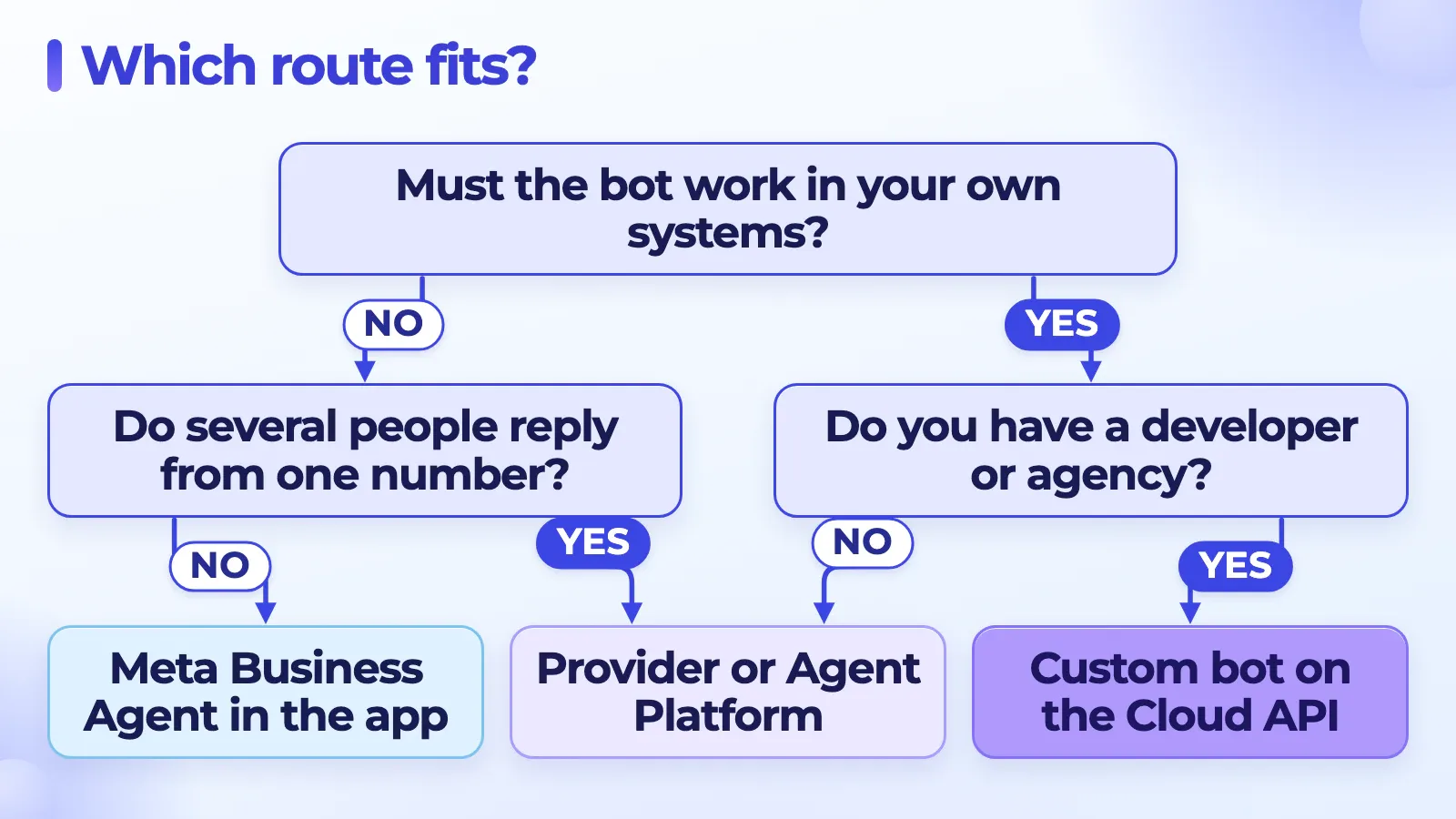
- There are three routes: the AI agent inside the WhatsApp Business app, a platform or solution provider, or a custom bot on the Cloud API. Pick by number of agents and integrations, not by hype.
- Meta allows bots that serve your own customers. General-purpose AI assistants have been barred from the WhatsApp Business Platform since 15 January 2026.
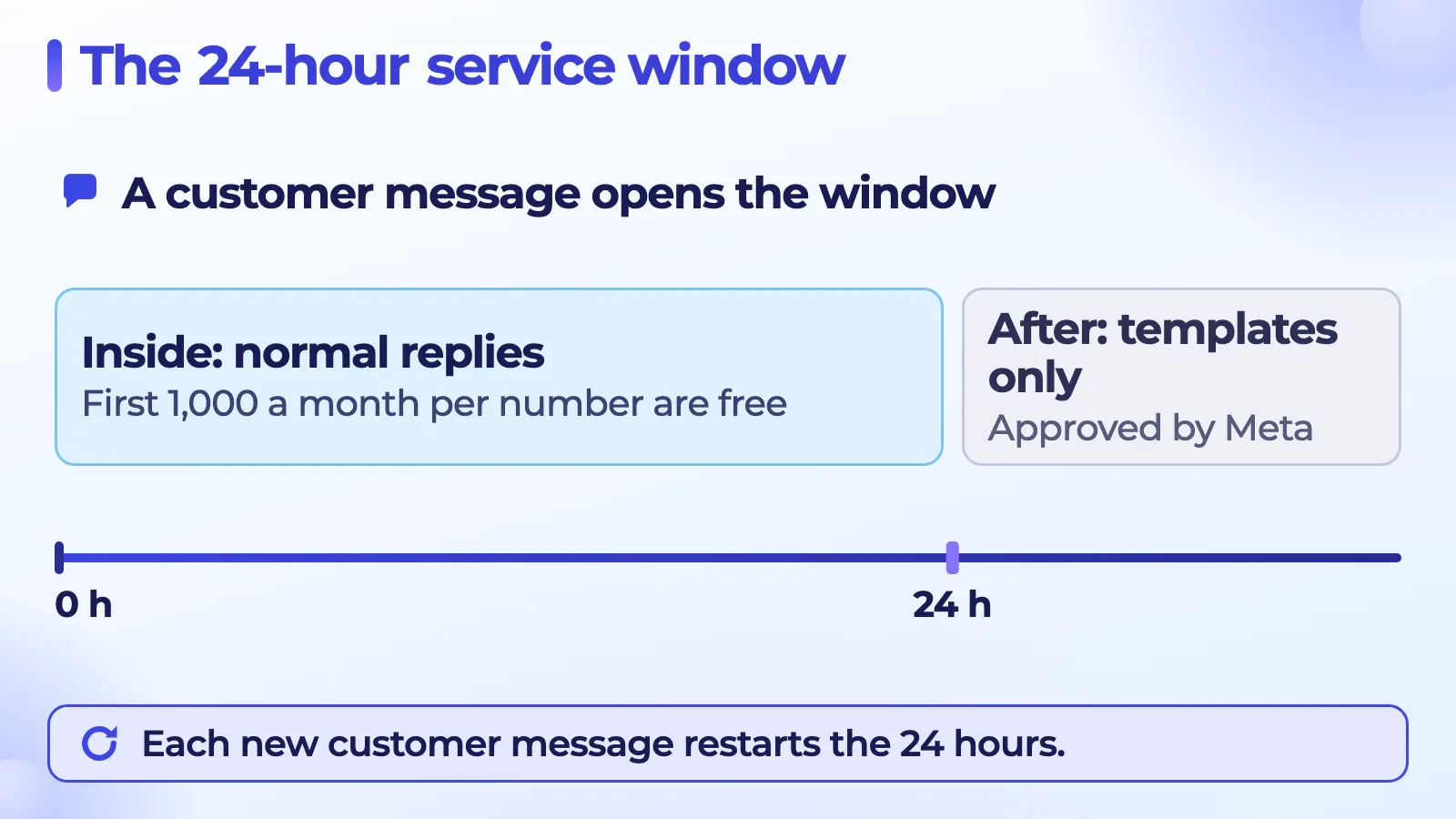
- Since 1 October 2026 replies are no longer free without limit. Each business number gets 1,000 free service messages a month, and Meta charges after that.
- Meta's policy requires a prompt, clear route to a person. Design the hand-off before you design the answers.
- Indonesia's PDP Law applies to every chat. Collect little, say what it is for, and have a 72-hour breach plan.
What a WhatsApp AI chatbot for business actually does
A chatbot sits between your customers and your team. It does two kinds of work, and the difference decides your budget.
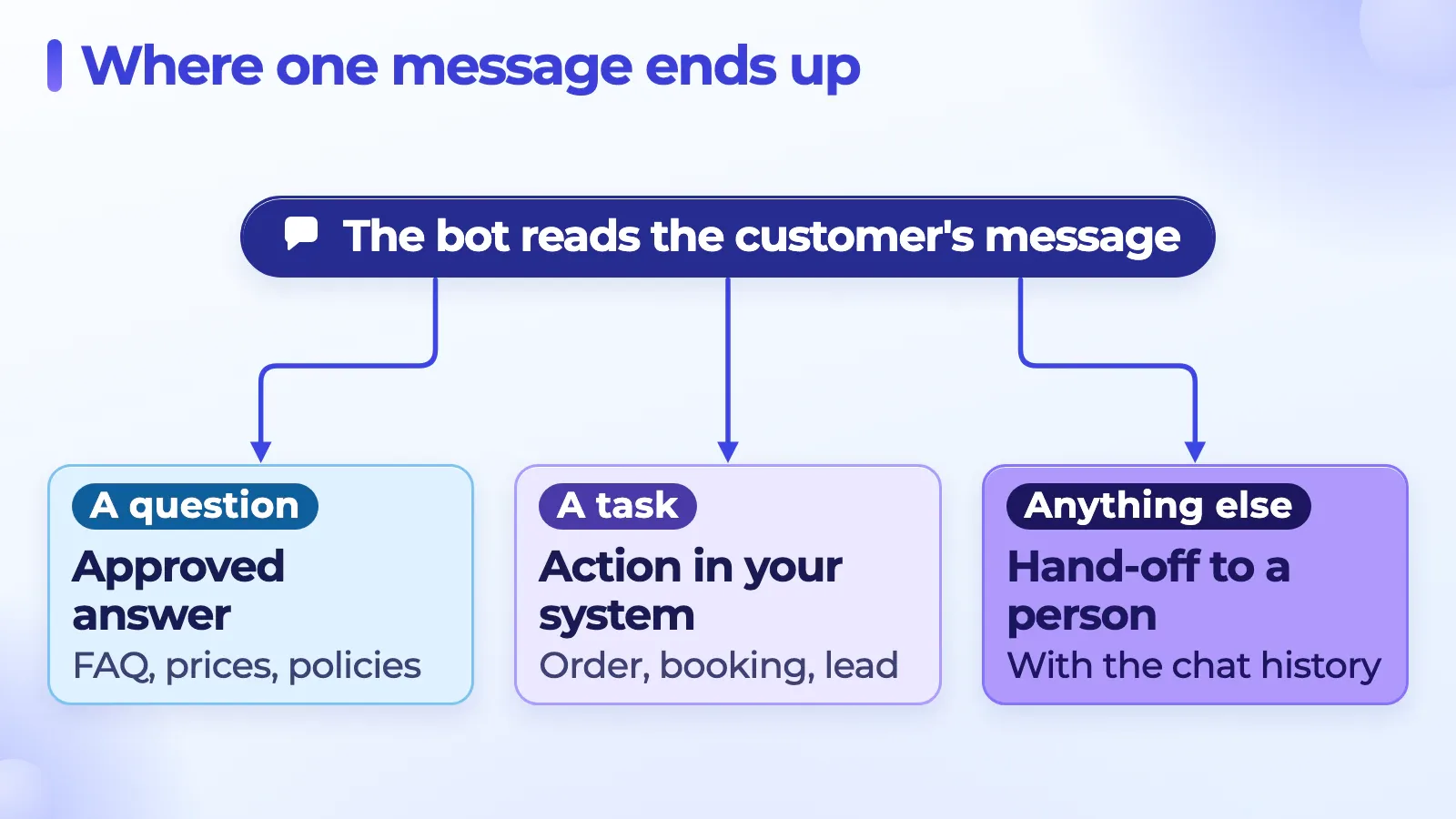
Answering means replying about opening hours, delivery areas, prices or returns. The bot only needs your approved content. Acting means doing something in your systems: checking an order, booking a slot or saving a lead. Actions need a connection to your order system, calendar or CRM, so they take longer to build and test.
AI is worth adding when customers write in their own words, mix Bahasa Indonesia and English, or ask one thing ten different ways. Buttons and short menus are still better for fixed choices, such as picking a branch or confirming a booking. Good bots use both.
Three ways to get one in Indonesia
There are three routes to a WhatsApp AI chatbot for business in Indonesia. They differ in control, effort and how Meta bills the bot's messages.
| Route | Best for | What you get | Trade-offs |
|---|---|---|---|
| Meta Business Agent in the WhatsApp Business app | One number, a small team, simple questions | An AI agent you train on your business. It can recommend catalogue products, book appointments and pass a chat to a team member | Least control over answers and data. Limited links to your own systems |
| Meta Business Agent Platform or a solution provider | Larger teams and common integrations | Platform: build and customise agents and connect them to business systems, per Meta's announcement. Provider: adds a shared agent inbox and ready-made connectors | Provider fees on top of Meta's charges. You depend on the provider's roadmap |
| Custom bot on the Cloud API | Your own order system, CRM or special logic | A bot you own, with your knowledge base and an AI model you choose | The most build and upkeep. You carry testing, hosting and monitoring |
The in-app agent. Meta announced Meta Business Agent for Indonesia at the Jakarta summit in August 2026. For small businesses it is switched on inside the WhatsApp Business app. Meta's pricing page does not cover the in-app agent, so check what the app shows for your account.
A platform or provider. The same report describes a Meta Business Agent Platform that lets larger companies build and customise agents and connect them to business systems. A solution provider can instead run the set-up for you and add a shared agent inbox and ready-made integrations.
A custom bot. You build on the Cloud API, keep your own knowledge base and choose the AI model. A number can also stay on the WhatsApp Business app while it is connected to the Cloud API, so staff keep replying from their phones. Meta's guide to onboarding WhatsApp Business app users says a solution partner or tech provider has to set this up. It also lists limits: 20 messages a second, and several app features that stop working. Ask the provider whether it is available for your number.
The Meta rules that shape your design
Business bots are allowed, general assistants are not
Meta changed its terms so that general-purpose AI assistants cannot use the WhatsApp Business Platform. TechCrunch reported that the change took effect on 15 January 2026, and that businesses using AI to serve their own customers are not affected.
The purpose of the WhatsApp Business API is to help businesses provide customer support and send relevant updates.
— Meta spokesperson, quoted by TechCrunch
The Meta Terms for WhatsApp Business Platform, last updated on 23 September 2026, also restrict your data. You must not let WhatsApp Business Platform data be used to create, develop, train or improve other AI models. Ask any provider to show you, in writing, how they comply.
The 24-hour window, templates and opt-in
When a customer messages you, a 24-hour customer service window opens. Each new customer message resets it. Inside the window your bot can send normal replies. Outside it, you can only send message templates that Meta has approved. Templates are filed as marketing, utility or authentication, and Meta's template guide says review can take up to 24 hours.
Two more limits catch new accounts. The WhatsApp Business Messaging Policy says you may only contact people who gave you their number and opted in to hear from you. A new business portfolio can also start chats with only 250 unique customers in any 24 hours, until it verifies the business or proves its quality, under Meta's messaging limits. Replies inside an open window do not count towards that limit.
What Meta charges
Meta's pricing page sets the charges. Meta has billed per delivered message since 1 July 2025. The rate depends on the message category and the country code of the customer's number. As of 1 October 2026:
- Service messages (normal replies inside the window) are free for the first 1,000 a month on each business number. Meta charges from message 1,001, and the allowance does not roll over.
- Utility templates are charged even when sent inside an open window. Marketing and authentication templates are charged too.
- Messages powered by the Meta Business Agent Platform have no free allowance. Meta bills them at USD 2.00 per million tokens, which it estimates at about 4 to 5 US cents a message. That one charge covers the AI and the delivery, so it replaces the service-message fee.
Take a shop with one number, 700 customer chats a month and four bot replies in each. That is 2,800 service messages. On a custom bot, 1,000 are free and 1,800 are charged at Indonesia's service rate. Meta's rate card, effective 1 October 2026, lists that rate at USD 0.025 a message, so the month costs about USD 45, plus your own AI model costs. On the Meta Business Agent Platform, Meta's estimate puts all 2,800 messages at roughly USD 112 to 140, with the AI included. Rates change, so run this sum with your own chat counts and the rate card linked from the pricing page before you choose a route.
Design the hand-off first
Meta's messaging policy allows automation inside the 24-hour window, but says you must also offer "prompt, clear, and direct escalation paths". It lists in-chat transfer to a human agent, a phone number, e-mail, web support, a shop visit or a support form. Decide these triggers before launch:
- The customer asks for a person, in any wording.
- The bot has failed to answer twice in a row.
- The topic is a complaint, a refund, a payment problem or anything legal.
- The answer is not in your approved content.
- The customer is angry or the order value is high.
Then decide who picks up. Name a person for office hours and a rule for nights and weekends, such as "we reply by 09:00". Pass the chat history along, so the customer does not repeat the story.
Designing for accurate answers
Ground replies in approved content. The safest bots answer only from what you have approved: catalogue, FAQ, prices and policies. Name one owner who updates that content on the day a price or policy changes.
Teach the bot to say "I don't know". Generative AI can state false things with confidence. The US National Institute of Standards and Technology calls this confabulation in its Generative AI Profile (NIST AI 600-1). A good bot admits the gap and hands over. It never guesses a price, a stock level or a refund rule.
Test both languages. Customers switch between Bahasa Indonesia and English in one sentence, and often add slang. Test every important question in both, and keep approved answers in both.
Customer data and Indonesia's PDP Law
Every chat holds personal data: names, numbers, addresses and order details. Law No. 27 of 2022 on Personal Data Protection sets the rules for handling it.
What the law requires, in short:
- A lawful basis for each use, such as explicit consent or carrying out a contract with the customer (Article 20).
- Proof of consent where you rely on it, for example before you add someone to marketing messages.
- Written notice to the affected people and the regulator within 72 hours if data leaks (Article 46).
- A way for people to object to decisions made only by automated processing that affect them significantly (Article 10).
More detail is on the way. An implementing regulation, Government Regulation (PP) No. 33 of 2026, was signed in July 2026 and takes effect on 16 January 2027. According to a summary by the law firm DFDL, it spells out what counts as valid consent, when the 72-hour clock starts and when an impact assessment is needed. We read summaries from law firms, not the official text.
Good practice on top of the law:
- Open with one line that says the customer is chatting with an AI assistant, and how to reach a person.
- Never ask for full card numbers or ID numbers in chat. WhatsApp's policy forbids asking for them.
- Set a retention period for chat logs and delete on schedule.
- Write the breach plan now, so the 72 hours are not spent deciding who does what.
This is a plain-language overview, not legal advice. For sensitive cases, speak to a lawyer.
Who does what
A first bot is a small project, but not a one-person job. These are rough planning figures for ten intents. Yours will vary.
| Task | Owner | Rough effort |
|---|---|---|
| Pick the top questions from real chat history | Customer service lead | Half a day |
| Write approved answers in Bahasa Indonesia and English | Marketing or product owner | Two to three days |
| Draft templates and submit them to Meta | Marketing, with the provider or developer | One day, plus review time |
| Connect the order system, calendar or CRM | Developer or agency | One to three weeks per system |
| Test scripts and a soft launch | Customer service and developer | One week |
| Weekly review of failed chats and content updates | Named content owner | One to two hours a week, ongoing |
A four-week launch checklist
Copy this list into your project board. It assumes a bot that answers questions first and takes actions later. Treat the four weeks as a planning assumption: business verification and template review can add time.
- Week 1: export a month of chats and tag the ten most common questions.
- Week 1: choose the route and confirm who owns content, hand-offs and data.
- Week 2: write approved answers and the opening AI disclosure line in both languages.
- Week 2: submit templates for delivery updates, reminders and re-engagement.
- Week 3: build the flows and hand-off rules, then test with awkward and off-topic questions.
- Week 3: record opt-in at every entry point: website form, checkout and click-to-chat link.
- Week 4: launch on one number or a small share of chats, and read every conversation daily.
- Week 4: review the numbers below and decide what to add next.
Track four numbers from day one:
- Resolution rate: chats that end without a person.
- Hand-off rate, and the reason for each hand-off.
- Waiting time for a first reply and for a person.
- Customer feedback: a thumbs up or down at the end of a chat.
Common mistakes
- Launching with 50 intents. Ten that work beat 50 that half work.
- Hiding the route to a person. It breaks Meta's policy and annoys customers.
- Forgetting templates, so the bot cannot send a delivery update after the window closes.
- Letting prices live in two places. The bot then quotes last month's price.
- Messaging people who never opted in. Templates with poor feedback get paused.
- Measuring only how many chats the bot handled, not how many it solved.
FAQ
Can I put ChatGPT or another general AI assistant on my WhatsApp Business number?
Not as a general-purpose assistant. Meta's terms have barred that since 15 January 2026. A bot that answers questions about your own business, products and orders is allowed, and it can use an AI provider behind the scenes.
Is the WhatsApp Business app enough, or do I need the API?
The app's built-in agent suits one number and simple questions. Several agents, links to your order system or CRM, or custom logic need the WhatsApp Business Platform. Through a solution partner or tech provider, a number can also stay on the app while it is connected to the Cloud API, with some limits.
How much does a WhatsApp AI chatbot for business cost to run?
Count three parts. Meta charges per delivered message after the 1,000 free service messages on each number. For Indonesian numbers that was USD 0.025 a service message when we checked the rate card on Meta's pricing page on 14 November 2026. Templates are charged by category and country. On top come build, hosting and AI model costs, or a provider's fee.
Can the chatbot reply in Bahasa Indonesia and English?
Yes. Modern language models handle both. Test each intent in both languages and keep approved answers in both.
How long does it take to launch?
Plan for about four weeks for a small bot that only answers questions. Business verification and template review can add time, and each system the bot must act in, such as orders or bookings, can add one to three weeks. These are planning figures, not a quote.
What do I need to do about customer data?
Collect only what the chat needs and say what it is for. Record consent where you rely on it, keep full card and ID numbers out of chat, and be ready to notify within 72 hours if data leaks.
Where GOTEN fits
A WhatsApp AI chatbot for business works best as one part of a bigger system: your website, catalogue, team and data. For a wider view, see The Future of AI in Everyday Applications.
If you are planning a project like this, our AI solution development service can help. If you sell over WhatsApp today, talk to us about your WhatsApp flows and we can look at a sensible first step together.