How to Choose a Web App Tech Stack: React, Node.js and More
How to choose a web app tech stack for your business: frontend, backend, database and hosting options, seven business questions and a sensible default for SMEs.
Choosing a web app tech stack feels like a technical decision, but it shapes your budget, hiring, speed of change and how long the product will last. Business owners do not need to know every framework, yet they should understand the main options and the questions to ask. This guide explains what a web app tech stack is, the common choices in 2026 and how to pick one that fits your business rather than a developer's personal taste.
What a web app tech stack is
A tech stack is the set of technologies used to build and run your product. Most stacks have four layers:
- Frontend: what users see and click in the browser, built with frameworks such as React, Vue or Angular.
- Backend: the server logic that handles accounts, payments, rules and integrations, for example Node.js, PHP (Laravel), Python (Django) or Go.
- Database: where data is stored, such as PostgreSQL, MySQL or MongoDB.
- Infrastructure: hosting, storage, deployment pipelines and monitoring on a cloud provider or VPS.
Popular web app tech stack options
React + Node.js + PostgreSQL
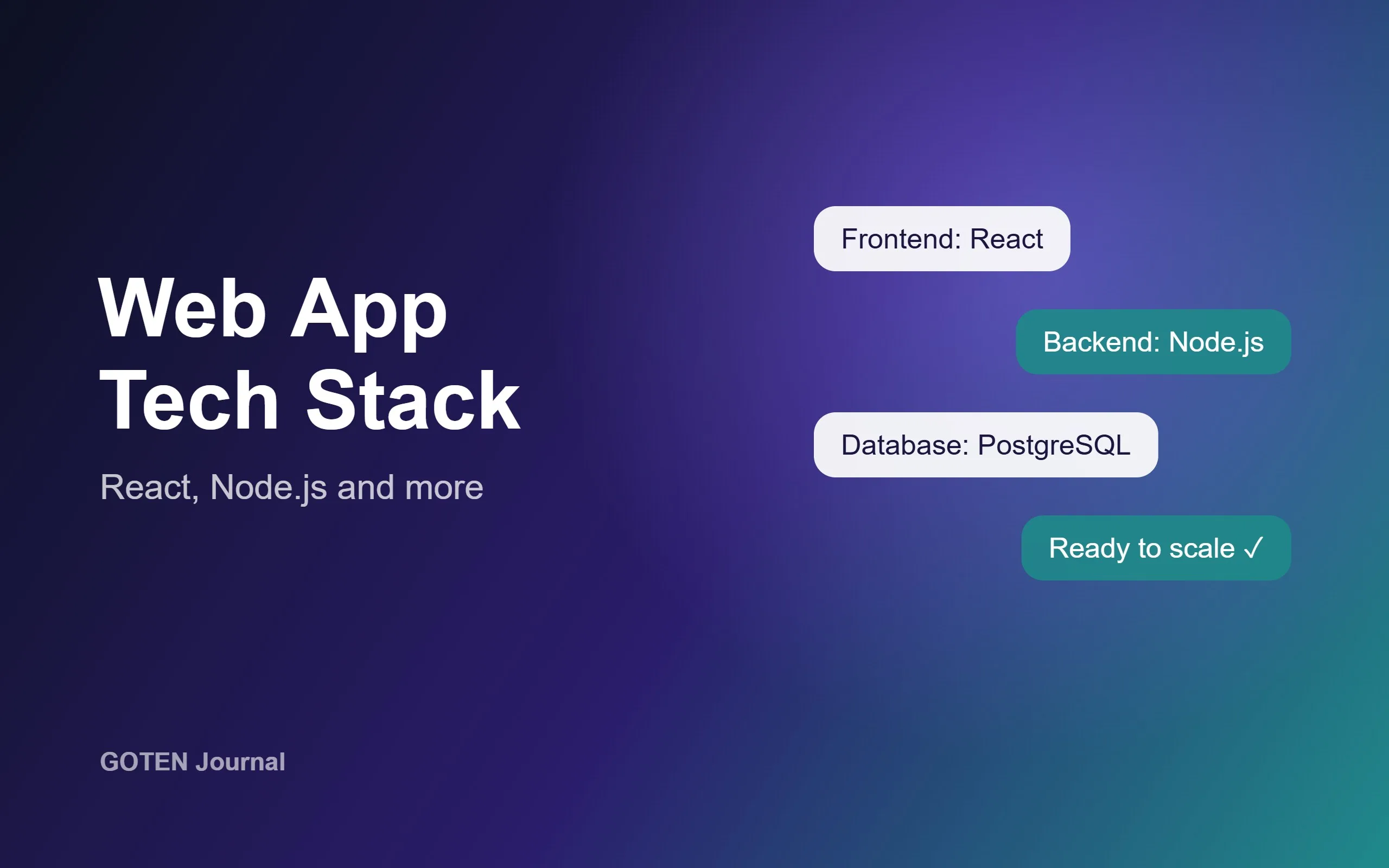
A very common modern choice. JavaScript or TypeScript runs on both frontend and backend, so one team can work across the whole product. It suits dashboards, portals, booking and membership systems, marketplaces and SaaS products. This is the stack GOTEN uses most, for example in membership and activity tracking systems built for our clients.
Laravel (PHP) + MySQL
Mature, widely known in Indonesia and quick for standard business applications. A good option when your future in-house team or vendor already works with PHP.
Django or FastAPI (Python)
Strong when the product is data-heavy or closely tied to AI and analytics, because Python has rich libraries for data and machine learning.
Low-code platforms
Useful for internal tools and quick prototypes, but limited for complex, customer-facing products. Our comparison of low-code vs custom development covers the trade-offs.
How to choose: seven business questions
- What are you building? A content site, a transactional web app, a mobile app or an AI-heavy product each favour different tools.
- How fast must the first version launch? Mature frameworks with ready-made components shorten time to market.
- Who will maintain it? Choose technologies that many developers in Indonesia know, so you are not locked to one person.
- Will you need a mobile app later? React on the web pairs naturally with React Native for mobile, sharing skills and sometimes code.
- How much traffic and data do you expect? Most business apps do not need exotic scaling; a well-built standard stack handles growth for years.
- What must it integrate with? Payment gateways, WhatsApp, ERPs and AI APIs all have good support in mainstream stacks; check before choosing anything unusual.
- What is the total cost of ownership? Licences, hosting, developer rates and maintenance matter more than the build price alone.
Mistakes to avoid when choosing your stack
- Choosing what is trendy rather than what fits. New tools can be exciting but risky for a business-critical system.
- Letting one freelancer pick an obscure stack. If they leave, you may struggle to find someone else.
- Ignoring hosting and maintenance. Some stacks are cheap to build but expensive to run. See website maintenance cost for what ongoing care involves.
- Over-engineering on day one. Microservices and complex infrastructure rarely make sense for a first version.
- Skipping documentation. Whatever you choose, insist on clear setup notes and code structure.
A sensible default for most Indonesian businesses
For most custom web apps, such as customer portals, booking and membership systems, dashboards and internal tools, a stack like React for the frontend, Node.js for the backend and PostgreSQL for data is a strong default. It is fast to build with, well supported, easy to hire for and ready for a mobile app or AI features later. The right choice can still differ if your team already has deep experience elsewhere, and that experience should count in the decision.
How the tech stack fits the bigger project
The stack is one decision among many. Scope, design, testing and launch planning matter just as much. Our guides to the web & app development process and web & app development cost explain how these pieces fit together.
FAQ
Does the tech stack affect SEO?
It can. Pages must load fast and be readable by search engines. Modern frameworks handle this well when set up with server-side rendering or pre-rendering.
Can we change the tech stack later?
Yes, but rewriting a working product is expensive. It is better to choose a mainstream stack first and improve it step by step.
Should the stack be the same for web and mobile?
Not necessarily, but sharing a language such as JavaScript or TypeScript between web, mobile and backend makes teams more efficient.
Questions to ask your developer or agency
- Why do you recommend this stack for our project, and what were the alternatives?
- How many other developers in Indonesia could maintain this code if needed?
- How will the system be hosted, backed up and monitored, and what will that cost each month?
- Who owns the code, the server accounts and the domain?
- How will we add a mobile app, payments or AI features later?
Clear, simple answers are a good sign. If the explanation is vague or full of jargon, ask again until you understand the trade-offs.
Get a stack recommendation from GOTEN
Tell us what you want to build, who will use it and what it must connect to, and we will recommend a web app tech stack that fits your goals and budget. See our web & app development services or read the full web & app development guide.