AI for Small Business: Ready-Made Tools or a Custom Solution?
AI for small business in Indonesia: when ready-made AI tools are enough, when a custom AI solution pays off, a side-by-side comparison and mistakes to avoid.
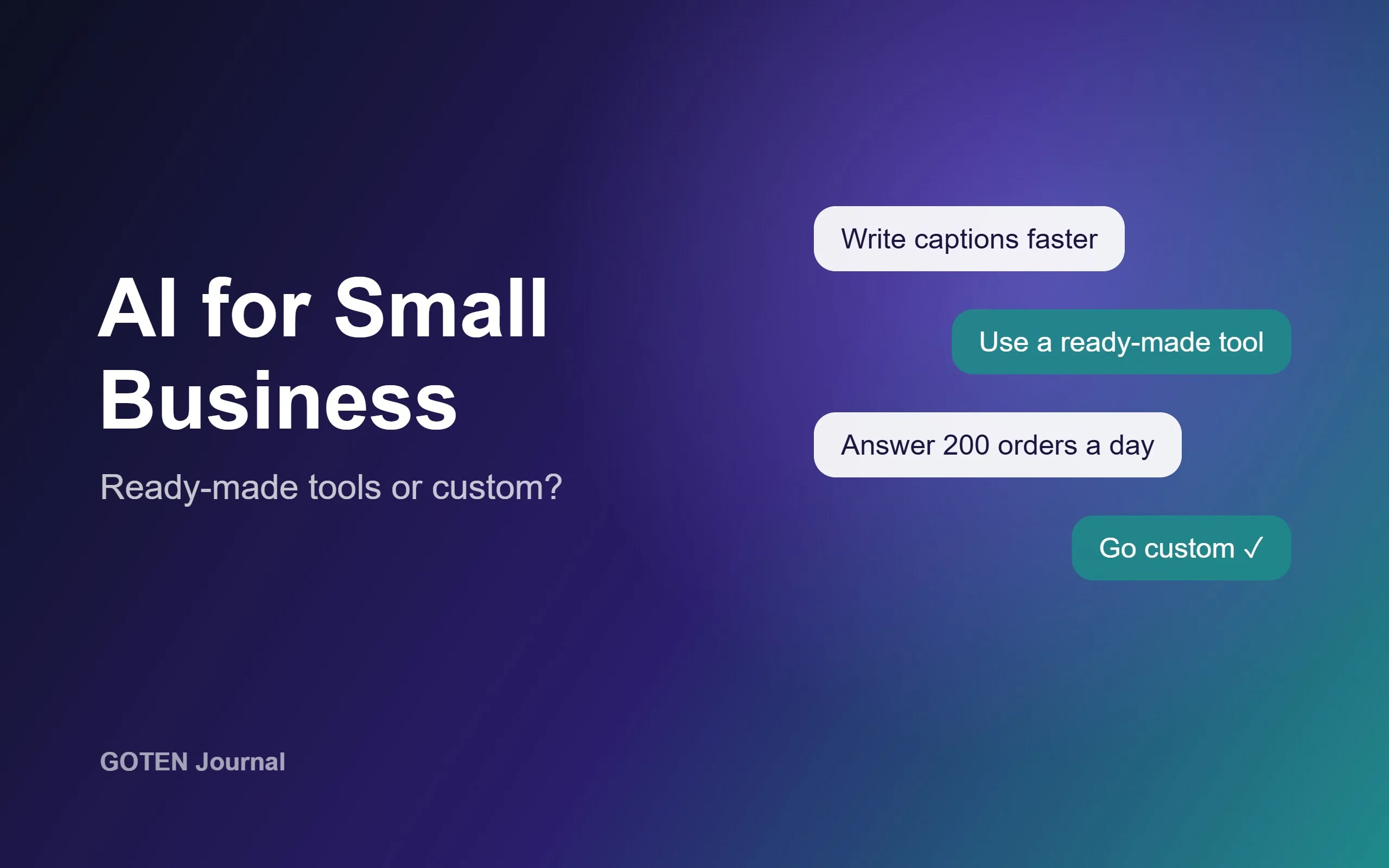
AI for small business no longer means expensive enterprise software. Many owners already use a chat assistant to write captions or reply to emails. The real question for a small company is when ready-made AI tools are enough and when a custom AI solution, connected to your own data and channels, is worth paying for. This guide helps Indonesian small businesses make that choice with a clear head.
Option 1: ready-made AI tools
These are general products you sign up for and use as they are: chat assistants, AI writing tools, AI features inside your accounting, design or marketplace software, and chatbot builders with templates.
When ready-made tools are enough
- The task is done by one person at a desk, such as drafting captions, emails or product descriptions.
- The AI does not need your live data, like stock, orders or customer history.
- Mistakes are easy to spot before anything reaches a customer.
- Volume is low enough that copy and paste is acceptable.
Limits to watch
- Data use. Consumer tools may have terms that do not suit customer data. Avoid pasting personal data into them.
- No integration. Staff copy information between tools by hand, which does not scale.
- Inconsistent results. Each person prompts differently, so tone and accuracy vary.
- Subscriptions add up. Several tools for several people can cost more than expected.
Option 2: a custom AI solution
A custom solution uses existing AI models, but is set up around your business: your prices and policies, your WhatsApp number or website, your spreadsheet or system, your rules for hand-offs and approvals. You do not train your own model; you shape how a proven model works for you.
When custom is worth it
- Customers talk to the AI directly, so accuracy and tone matter.
- The AI must read or update live information, such as stock, bookings or order status.
- The same task happens dozens or hundreds of times a week.
- You need clear rules on data, approvals and who can see what.
Examples include a WhatsApp assistant that checks orders, an invoice reader that fills your accounting sheet, or a quotation helper that uses your real price list. Our WhatsApp AI chatbot guide shows one common case in detail.
Side-by-side comparison
- Setup time: ready-made tools take minutes; custom solutions take weeks for a focused first version.
- Upfront cost: low for tools; a one-off build cost for custom.
- Running cost: per-user subscriptions for tools; usage-based AI and channel costs plus support for custom.
- Fit with your data: limited for tools; designed around your data for custom.
- Control and privacy: depends on vendor terms for tools; set by you and your partner for custom.
For a realistic breakdown of custom costs, read AI for business cost: what you actually pay for.
A practical path for AI for small business
- Start with ready-made tools for internal work. Let your team get comfortable with AI for writing and summarising, with a simple rule: no customer personal data in consumer tools.
- Spot the repeated, customer-facing tasks. Notice which questions, documents or requests eat the most hours.
- Run one custom pilot. Build a small, focused solution for the most painful task and measure it. Our 30-day AI pilot plan shows how.
- Grow from what works. Reuse the same knowledge base and integrations for the next use case.
Mistakes to avoid
- Buying many tools at once. Several overlapping subscriptions that nobody uses fully. Start with one and learn.
- Letting AI talk to customers without rules. A general chatbot with no limits can promise discounts or give wrong information. Customer-facing AI needs clear instructions and a route to a person.
- Skipping the information clean-up. If your price list lives in three versions, the AI will repeat the confusion. Fix the source first.
- Building custom too early. A custom system for a task that happens five times a month rarely pays back. Volume should justify the build.
- Forgetting the team. Staff need to know what the AI does, when to step in and how to update it. A short training session prevents most problems.
Questions to ask before you decide
- Will customers see the AI's output directly?
- Does the AI need live data from our systems?
- How many times a week does this task happen?
- What would a mistake cost us?
- Does the tool's data policy fit Indonesia's Personal Data Protection Law (UU PDP) and our own rules?
If most answers point to customer-facing, live data, high volume and costly mistakes, a custom solution is usually the better investment. If not, a ready-made tool is a perfectly good start.
FAQ
Is AI for small business affordable in Indonesia?
Yes, when you start small. Ready-made tools cost little, and a focused custom pilot on one channel is far cheaper than a full system.
Can we switch from a tool to a custom solution later?
Yes. The prompts, FAQs and policies you write while using tools become the starting knowledge for a custom solution.
Will a custom AI lock us into one vendor?
Ask your partner to document the setup and keep your knowledge base and data in places you own. That keeps your options open.
Talk to GOTEN
Not sure which path fits your business? Tell us your busiest tasks and we will tell you honestly whether a tool or a custom build makes sense. See our AI solution development services or read the full AI for business guide.
Whichever path you choose, start small, measure honestly and let real results, not hype, decide your next step.