AI Data Privacy: A PDP Law Checklist for Businesses
A practical AI data privacy checklist for Indonesian businesses under the PDP Law (UU PDP): data mapping, consent, providers, retention, incidents and customer rights.
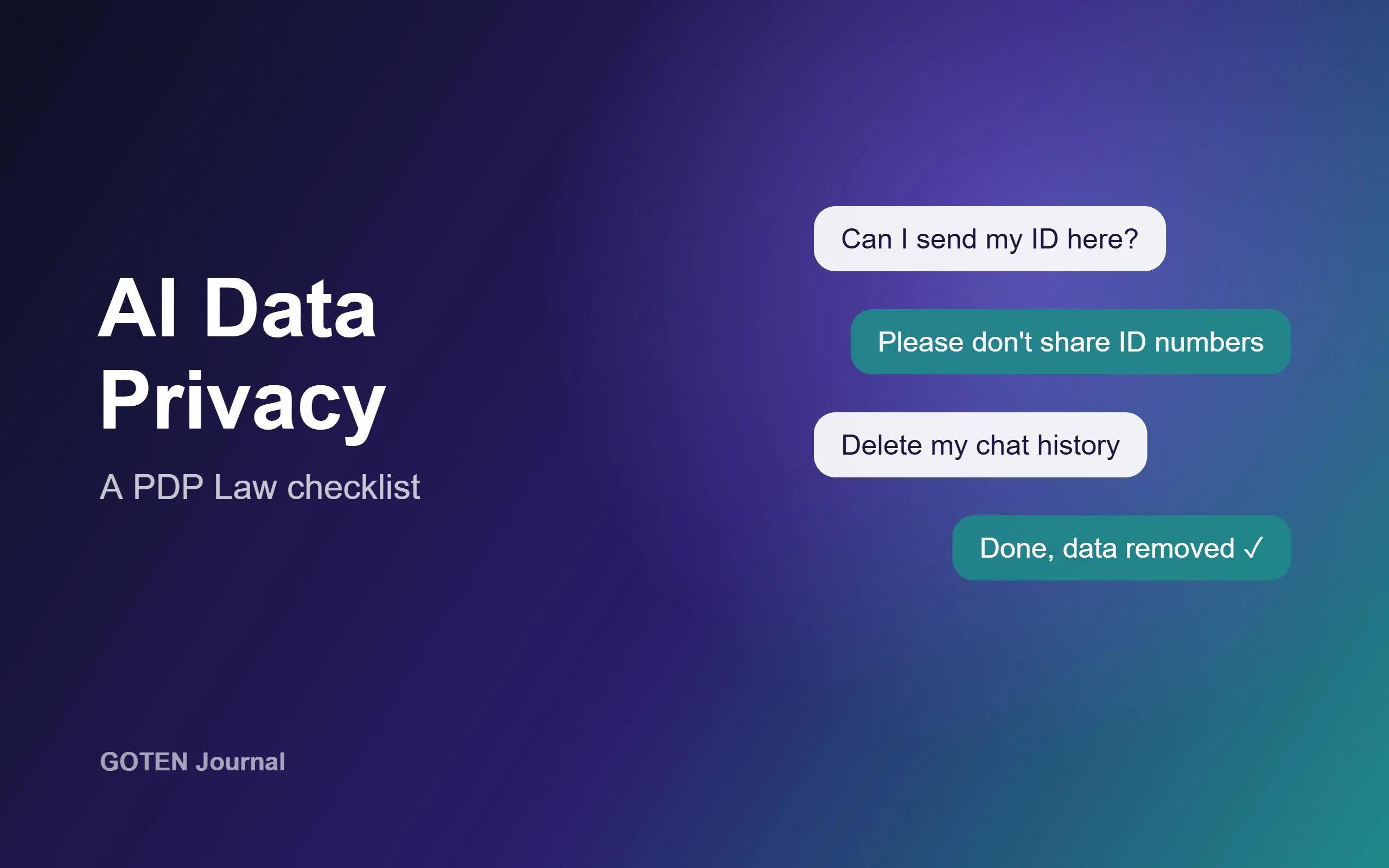
AI data privacy is the part of an AI project that business owners most often leave until last, and it should come first. Chatbots and automations handle names, phone numbers, addresses and order histories every day. In Indonesia, that data is protected by Law No. 27 of 2022 on Personal Data Protection (UU PDP). This checklist helps you build AI that customers can trust and that respects the law. It is practical guidance, not legal advice; check specific situations with a legal adviser.
Why AI data privacy matters
- More data moves around. AI tools connect chat channels, databases and outside AI providers, so personal data travels further.
- Customers share freely in chat. People type addresses, ID details and payment problems into WhatsApp without thinking.
- Mistakes scale. A misconfigured bot can expose data to many customers at once.
- Trust is the product. One privacy incident can undo years of reputation.
The AI data privacy checklist
1. Know what data the AI touches
List every field the AI reads or stores: names, phone numbers, addresses, order details, chat history. Mark which are personal data and which are sensitive.
2. Collect only what you need
If the bot only needs an order number to check status, do not ask for a full address. Remove fields that are "nice to have".
3. Be clear about purpose and consent
Tell customers they are chatting with an AI assistant, what data it uses and why. Record consent where you rely on it, such as for marketing follow-ups.
4. Keep sensitive data out of chat
Ask customers not to send full card numbers, ID numbers or passwords in chat, and configure the AI to warn them and avoid storing such data if they do.
5. Check your AI and hosting providers
Know where data is processed and stored, whether providers use it to train their models, and how long they keep it. Prefer settings and plans that do not use your business data for training.
6. Control access
Give staff and tools access only to the data their role needs. Use strong passwords and two-factor authentication on every admin account.
7. Set retention rules
Decide how long chat logs and AI outputs are kept, and delete them when they are no longer needed.
8. Plan for incidents
Write down who does what if data leaks: how you investigate, who you inform and how quickly. UU PDP sets notification duties for data breaches, so the plan should be ready before you need it.
9. Let customers exercise their rights
Customers can ask to see, correct or delete their data. Make sure your team knows how to do this across chat logs, CRMs and AI tools.
10. Review regularly
Every few months, review a sample of AI conversations for privacy issues and update your settings and policies.
AI data privacy for WhatsApp chatbots
WhatsApp is the most common AI channel in Indonesia, and it has its own rules. Meta requires opt-in for business-initiated messages and clear routes to a person. Our WhatsApp AI chatbot guide covers these rules alongside UU PDP basics, and our guide to AI customer service explains how to design safe hand-offs to your team.
Privacy by design, not as an afterthought
The cheapest time to get AI data privacy right is during design: choosing which data the AI may see, which tools it may use and which actions need approval. Adding controls after launch is slower and more expensive. This is especially true for AI agents, which connect to more systems than simple chatbots.
Questions to ask before connecting AI to customer data
- Which personal data fields will the AI see, and why does it need each one?
- Which AI provider processes the data, in which region, and under which terms?
- Is customer data used to train the provider's models? Can this be switched off?
- Who in our team and the vendor's team can read chat logs?
- How long are logs kept, and how are they deleted?
- What happens if a customer asks us to delete their data?
- Who is notified first if something goes wrong, and how fast?
If you or your vendor cannot answer these clearly, pause the launch until you can. Good AI data privacy is mostly about clear answers to simple questions, written down before the first customer chats with your assistant.
Does privacy make AI more expensive?
A little, at the start: mapping data, configuring providers and writing an incident plan take time. But these steps are far cheaper than fixing a leak, rebuilding customer trust or reworking a system after launch. Budget for them from the first estimate. Our article on AI for business cost shows where privacy work fits in a typical project budget.
FAQ
Does UU PDP apply to small businesses?
The law applies to organisations that process personal data, regardless of size. The practical steps above are a sensible baseline for any business using AI with customer data.
Is it safe to use public AI chat tools with customer data?
Avoid pasting customer personal data into consumer AI tools. Use business plans or APIs with clear data-use terms, configured by your team or vendor.
Who is responsible if the AI leaks data, us or the vendor?
Responsibilities depend on your contracts and roles under the law. Agree in writing what your vendor does with data and how incidents are handled.
Build AI your customers can trust
We design AI chatbots and automations with privacy controls from day one. Read our AI for business guide, see our AI solution development services, or talk to GOTEN about your project.