AI for Business Cost: What You Actually Pay For
What AI for business really costs in Indonesia: build and integration, monthly usage, running costs, what pushes the bill up and how to budget in phases.
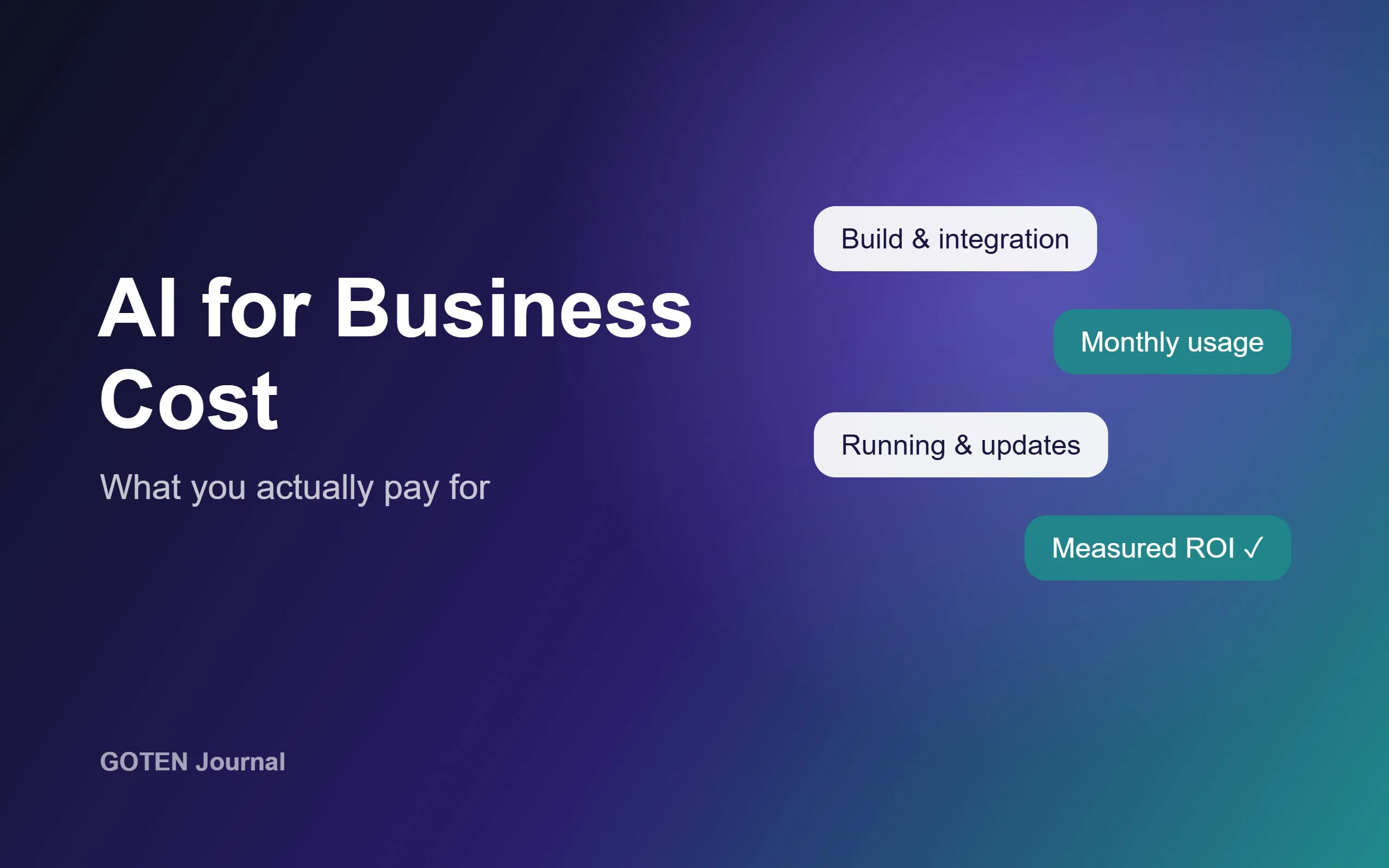
"How much does AI cost?" is a fair question, and the answer surprises many business owners: the AI model itself is often the smallest part of the bill. AI for business cost is driven mostly by how much setup and integration the project needs, how much it is used, and who keeps it accurate over time. This guide breaks down each part so you can plan a budget with no surprises.
The three parts of AI for business cost
1. Build and integration (one-off)
This is the work to design the conversations or workflow, connect the AI to your systems (WhatsApp, website, order database, spreadsheets, CRM), write the instructions and safety rules, and test it with real cases. It is usually the largest one-off cost, and it grows with the number of systems and the complexity of the rules.
2. Usage (monthly)
AI providers charge by usage, typically per amount of text processed. Current rates are published on pages such as OpenAI API pricing and Anthropic pricing. For a typical SME chatbot or document workflow, model usage is often modest compared with staff time saved, but it rises with volume and with longer documents. Channel costs come on top: WhatsApp, for example, charges per message for certain message types under Meta's pricing.
3. Running and improvement (ongoing)
Someone must update prices, policies and product information, review conversations, fix wrong answers and adjust the flows as your business changes. This can be your own staff, your vendor or both. Skipping it is the fastest way to turn a good AI into a bad one.
What pushes AI for business cost up
- Integrations. Every system the AI reads from or writes to adds work and testing.
- Unclear processes. If the steps are not written down, discovery takes longer.
- Messy knowledge. Outdated price lists or conflicting policies must be cleaned before launch.
- High accuracy needs. Finance, legal or medical topics need more checks and human review.
- Many channels at once. WhatsApp, website and Instagram together cost more than one channel.
- Custom dashboards and reports. Useful, but add build time.
What keeps it down
- Start with one use case. One channel, the top questions or one document type.
- Use existing models. Training your own model is rarely needed.
- Choose the right model size. Smaller, cheaper models handle many routine tasks well; reserve larger models for harder ones.
- Keep answers short and focused. Less text processed means lower usage costs.
- Reuse what you have. Connect to your current spreadsheets or systems before building new ones.
How to estimate the return
Compare cost with value using simple numbers you already know:
- Hours per week your team spends on the task, multiplied by hourly cost.
- Leads lost because replies came too late, especially at night.
- Errors in manual work and what they cost to fix.
If an AI customer assistant handles a large share of routine questions, the saved hours and faster replies often outweigh the monthly running cost. Measure this during a short pilot rather than guessing. Our guide to AI customer service lists the metrics to track.
Plan the budget in phases
The safest way to manage AI for business cost is to spend in stages, each with a clear decision point:
- Discovery. Map the task, collect sample data and define success measures. Small cost, big clarity.
- Pilot. Build the smallest useful version on one channel or one document type, and run it with real users for a few weeks.
- Launch. Harden what worked: monitoring, hand-offs, admin tools and training for your team.
- Expand. Add new channels, topics or workflows only when the numbers from the previous stage justify it.
Phasing turns a large, uncertain investment into a series of small, measurable ones, and gives you the option to stop early if the results are not there.
Questions to ask any AI vendor
- Which AI models do you use, and who pays the usage bill?
- What happens when the AI is unsure? How does it hand over to a person?
- How do we update prices, FAQs and policies ourselves?
- Where is customer data stored, and for how long? See our AI data privacy checklist.
- What does support cost after launch?
- Can we see a similar project running today?
How AI cost compares with web and app projects
AI projects are often smaller to build than a full website or app, but they have higher ongoing usage costs. Many businesses combine both: a fast website or web app plus an AI assistant. For the web side, see web & app development cost in Indonesia.
FAQ
Is there a monthly subscription for AI?
Usually you pay the AI provider by usage and your vendor for support. Some platforms bundle both into a subscription; check what is included.
Can costs suddenly spike?
They can if usage grows quickly or a workflow processes very long documents. Set usage limits and monitor monthly reports.
Do we need to train our own AI model?
Almost never. For customer service, document processing and internal assistants, existing models plus your own knowledge base and clear instructions are enough. Custom training adds cost and maintenance that most SMEs do not need. Agent-style workflows are covered in our guide to AI agents for business.
Is a pilot worth paying for?
Yes. A short pilot is the cheapest way to learn whether AI for business works for your specific task before investing more.
Get a clear estimate
Tell us the task you want to automate, the channels involved and rough volumes, and we will outline the build, usage and running costs. See our AI solution development services or read the full AI for business guide.