AI for Business in Indonesia: A Practical Guide
Where AI for business pays off for Indonesian SMEs: chatbots, workflow automation and AI features, what to avoid, costs and how to start with a small pilot.
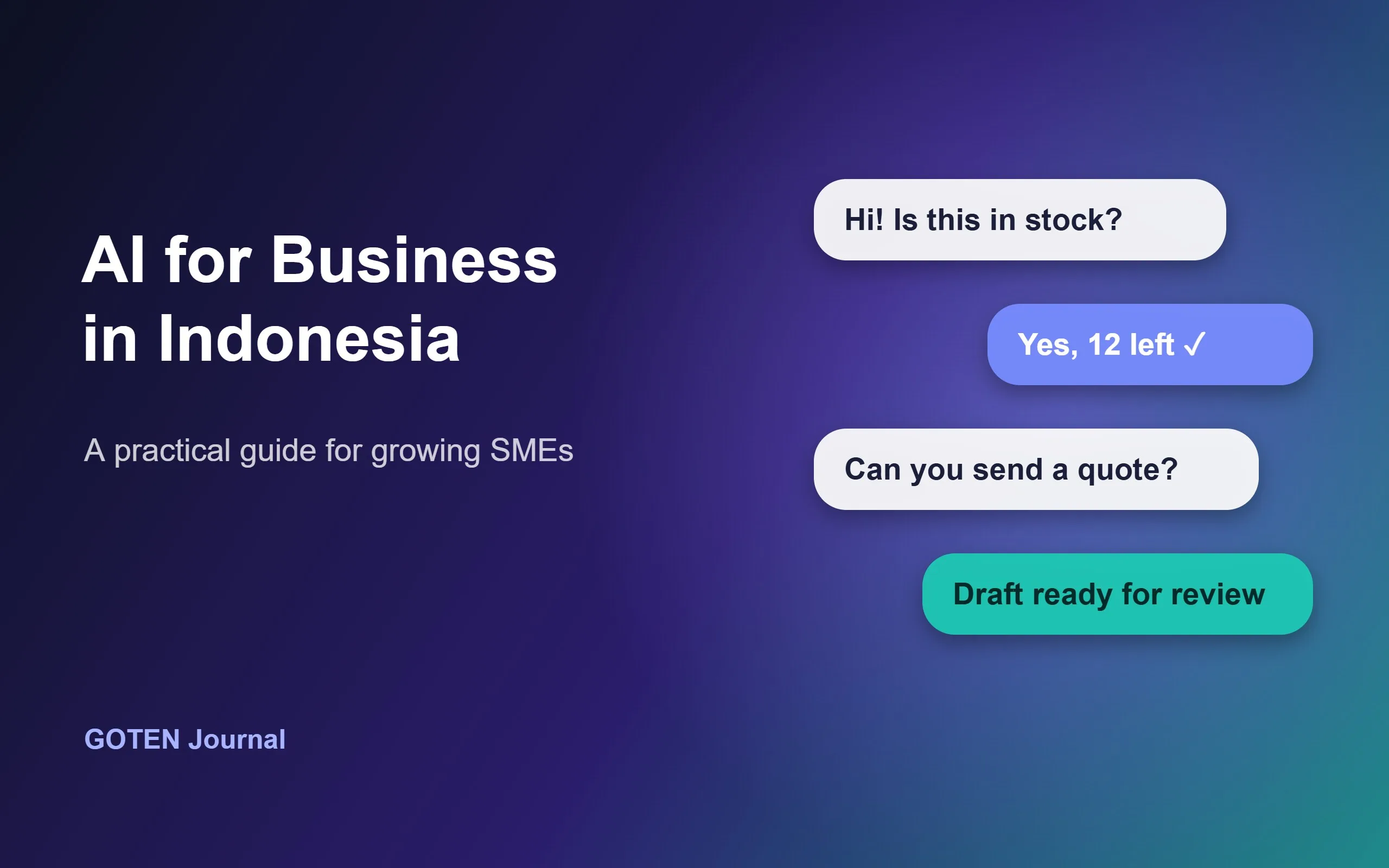
AI for business is no longer a project only large companies can afford. For a growing business in Indonesia, it usually means something practical: answering customers faster, taking repetitive work off your team and making better use of the data you already have. This guide explains where AI for business actually pays off, where it does not, and how to start without wasting budget.
What AI for business really means
Most useful business AI today falls into four groups:
- Conversational AI. Assistants that answer questions on WhatsApp, your website or Instagram, qualify leads and hand complex cases to a person.
- Workflow automation. AI that reads documents, fills in forms, drafts replies or reports, and moves data between systems, with a person approving the result.
- Search and knowledge. Tools that let staff or customers ask questions in plain language and get answers from your own manuals, price lists and policies.
- AI features inside products. Smart search, recommendations, summaries or image recognition built into your website or app.
All four rely on large language models and related tools from providers such as OpenAI, Anthropic and Google. What makes them valuable is not the model itself, but how well it is connected to your data, your processes and your team.
Where AI for business pays off first
Look for work that is frequent, repetitive and based on information you already have. Common first wins for Indonesian SMEs:
- Customer questions on WhatsApp. Prices, stock, opening hours, delivery status. A WhatsApp AI chatbot answers these instantly, day and night.
- Lead qualification. Asking the right questions before a salesperson steps in, so the team spends time on serious buyers.
- Quotations and documents. Drafting quotes, invoices or shipping documents from a few inputs, ready for a person to check.
- Status updates. Sending order or shipment updates automatically instead of answering the same question by hand.
- Internal knowledge. Letting new staff ask "how do we handle a return?" and get the answer from your own SOPs.
We cover how to choose and roll out these use cases in AI customer service: what to automate first.
Where AI is not the right tool (yet)
- Decisions that need judgement, accountability or empathy, such as complaints, refunds or legal questions.
- Processes that are not written down. If your team cannot explain the steps, an AI cannot follow them.
- Tasks that happen a few times a month. The setup cost will not pay back.
- Anything where a wrong answer is costly and nobody checks the output.
Generative AI can state false things with confidence. Frameworks such as the NIST AI Risk Management Framework are a good reminder to keep a person in the loop wherever mistakes matter.
Chatbots, automations and AI agents
You will hear three terms. A chatbot answers questions in a conversation. An automation runs a fixed sequence of steps, using AI for the parts that need reading or writing. An AI agent decides which steps to take and which tools to use to reach a goal. Agents are powerful but harder to control; most businesses get more value from well-designed chatbots and automations first. Read AI agents for business for a closer look.
How to start an AI for business project
- Pick one problem. Choose a task that costs real time or sales every week.
- Measure today. How many messages, how long per quote, how many errors? You need a baseline to prove results.
- Prepare the knowledge. Collect FAQs, price lists and SOPs. Clean, current information matters more than the model you choose.
- Run a small pilot. Two to four weeks, one channel, a small group of users, with a person reviewing outputs.
- Decide with data. Keep, improve or stop based on the numbers, then expand step by step.
What it costs
An AI for business project usually has three cost parts: building and connecting it, paying for AI usage and messaging, and keeping the knowledge up to date. We break these down in AI for business cost, with tips to keep monthly bills predictable.
Protect your customers' data
Any AI that handles names, phone numbers or orders must follow Indonesia's Personal Data Protection Law. Collect only what you need, explain why, and know where the data goes. Our AI data privacy checklist covers the essentials.
A real example of automation
Not every win needs a chatbot. For Indo Agro Coco, a coconut exporter, we replaced manual shipment updates with a tracking portal that the team and its buyers both use. The team now spends around 70% less time on status updates. The same thinking applies to AI: find the repeated question or task, then remove it from people's day.
FAQ
Is AI for business only for large companies?
No. Small teams often benefit most, because one automation can free hours every week for people who wear many hats.
Do we need our own AI model?
Almost never. Most businesses use existing models from major providers and focus on connecting them to their own data and processes.
Will AI replace our customer service team?
It works best as a first line that handles routine questions and passes complex cases to people, so the team can focus on conversations that need a human.
How long does a first project take?
A focused pilot often takes two to six weeks, depending on how ready your knowledge and systems are.
Work with GOTEN
GOTEN Digital builds AI chatbots, workflow automations and AI features for growing businesses in Indonesia. See our AI solution development services or tell us which task you want to automate first.