AI Pilot Project: A 30-Day Plan for Your Business
A practical 30-day AI pilot project plan for Indonesian businesses: pick one use case, prepare the knowledge, test, go live with a small group and decide with numbers.
The safest way to start with AI is not a big transformation programme but a small, measured experiment. An AI pilot project lets you test one idea with real customers or real documents for a few weeks, learn what works and decide with numbers whether to continue. This article gives a practical 30-day AI pilot project plan that Indonesian businesses can follow without a large budget or an in-house AI team.
What an AI pilot project is, and is not
A pilot is a small, complete version of one use case running in real conditions. It is not a demo that only works with prepared examples, and it is not a full rollout across every channel. A good AI pilot project has one goal, one channel or document type, a limited group of users and clear success measures agreed before it starts.
Before day one: pick the right use case
Choose a task that happens often, costs real time today and is easy for a person to check, such as answering order questions on WhatsApp or reading supplier invoices. Our list of AI for business use cases includes a simple scoring method to help you decide.
Then write down three things:
- The goal. For example, "answer 50% of routine order questions without staff".
- The baseline. How long the task takes today, how many cases per week, and current error or response times.
- The owner. One person in your team who decides, reviews results and talks to the vendor.
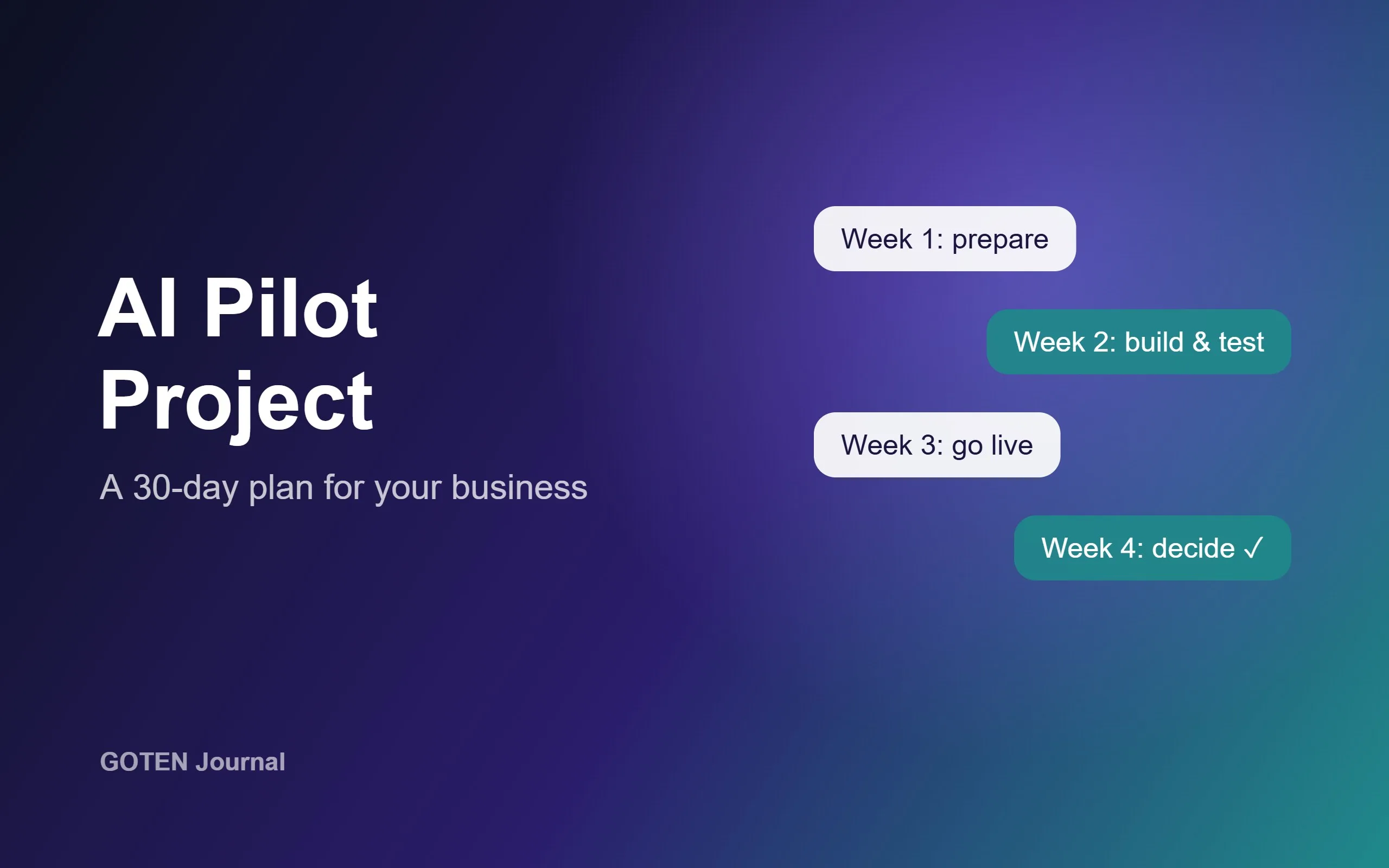
Week 1: prepare the knowledge and the rules
- Collect real examples. Export a few hundred past chats, emails or documents. These show how customers actually write, including typos and mixed Indonesian and English.
- Write the source of truth. Current prices, policies, product details and FAQ answers in one place the AI can read.
- Decide the limits. Which topics the AI must never answer alone, such as complaints, refunds or anything legal, and when it must hand over to a person.
- Check data privacy. Confirm which personal data the pilot touches and how it is stored. Our AI data privacy checklist lists the questions.
Week 2: build and test internally
The developer or partner sets up the AI assistant or workflow, connects it to the chosen channel or system and writes its instructions. Your team then tests it with the real examples from week 1, not only easy ones. Keep a simple sheet of every wrong or weak answer and fix the knowledge or rules behind it. By the end of the week, internal testers should be comfortable that routine cases are handled well and that hand-offs work.
Week 3: go live with a limited group
Open the pilot to real users in a controlled way: one WhatsApp number, one outlet, one product line or a share of incoming documents. Staff stay ready to take over. Review a sample of conversations or outputs every day and keep fixing gaps. Expect the first days to surface questions nobody predicted; that is the point of the AI pilot project.
Week 4: measure and decide
Compare the results with your baseline:
- Share of cases handled without staff, or documents processed without correction.
- Response time and customer satisfaction.
- Hours saved per week.
- Errors and complaints caused by the AI.
- Running cost per month, including AI usage and channel fees. See AI for business cost for what to include.
Then make one of three decisions: scale it up, improve and extend the pilot, or stop. Stopping is a valid result. A pilot that shows a use case does not pay off has saved you from a much larger mistake.
Common reasons an AI pilot project fails
- No baseline. Without numbers from before, nobody can prove the pilot helped.
- Outdated information. The AI repeats old prices or policies, and trust drops quickly.
- Too many goals at once. Three channels and five use cases in one month rarely work.
- No owner. Problems pile up because nobody is responsible for reviewing and deciding.
- Hidden hand-offs. Customers get stuck because the route to a person is unclear.
Who should be involved
Keep the team small: the owner who decides, one or two staff who do the task today and know its exceptions, and the developer or partner who builds it. Frontline staff are the most valuable testers because they know which questions customers really ask and which answers would cause trouble. Involve them from week 1, and share the week 4 results with them so they see what changed.
What happens after a successful pilot
Scaling usually means adding monitoring, admin tools for your team to update information, more channels or document types, and regular review routines. Many businesses then move from a simple assistant to fixed automations and, later, to narrow AI agents for business. Guidance like the NIST AI Risk Management Framework recommends keeping that oversight in place as systems grow.
FAQ
Is 30 days enough for an AI pilot project?
For a focused use case on one channel, yes. More complex integrations may need six to eight weeks, but the same weekly structure applies.
Should customers know they are talking to AI?
Yes. Be open that it is an assistant and make it easy to reach a person. Transparency builds trust and reduces complaints.
Can we run a pilot with our existing tools?
Often. Many pilots connect to the spreadsheets, WhatsApp Business account or systems you already use, which keeps cost and time low.
Plan your pilot with GOTEN
We help Indonesian businesses design and run focused AI pilots, then scale what works. See our AI solution development services or start with the full AI for business guide.