AI Chatbot vs Live Chat: Which Does Your Business Need?
AI chatbot vs live chat compared for Indonesian businesses: speed, cost, strengths and limits of each, and how a hybrid model gives customers fast, human support.
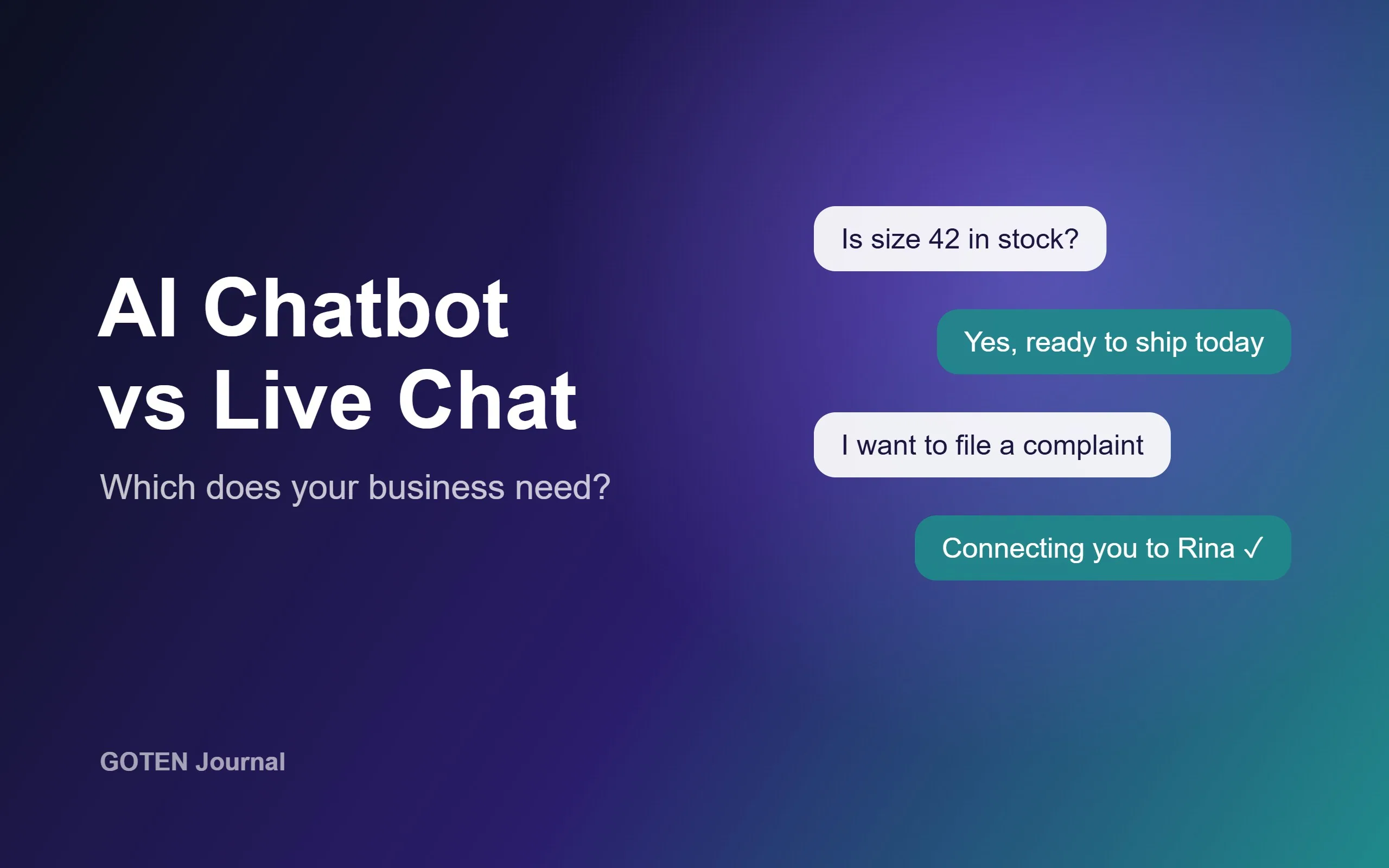
Customers in Indonesia expect fast answers on WhatsApp, Instagram and your website. Businesses usually respond in one of two ways: a team of people answering through live chat, or an AI chatbot that replies automatically. The AI chatbot vs live chat question is not really either-or. This guide compares both, shows where each one shines and explains how to combine them so customers get speed without losing the human touch.
What live chat does well
Live chat means real people answering messages, usually through WhatsApp Business, a website chat widget or a shared inbox.
- Empathy and judgment. People handle complaints, negotiations and unusual requests far better than software.
- Selling. A skilled salesperson can read the customer, recommend, upsell and close.
- Trust. Some customers, especially for high-value purchases, want to know a real person is there.
The weaknesses are speed and cost: people need breaks, sleep and training, and response times grow when messages spike after a promotion or outside office hours.
What an AI chatbot does well
A modern AI chatbot uses a language model plus your own information, such as prices, policies and stock, to answer in natural language.
- Instant replies, 24/7. No queue at night, on weekends or during campaigns.
- Consistency. The same correct answer every time, in Indonesian, English or the mix customers actually type.
- Scale. Hundreds of conversations at once without extra staff.
- Data. Every question is logged, showing what customers ask most.
The weaknesses: it can give wrong answers if your information is outdated, and it should not handle sensitive complaints or decisions alone.
AI chatbot vs live chat: side-by-side
- Response time: chatbot instant; live chat depends on staff availability.
- Hours: chatbot 24/7; live chat usually office hours unless you run shifts.
- Best for: chatbot handles routine questions; live chat handles complex, emotional or high-value conversations.
- Cost pattern: chatbot has setup plus usage costs; live chat costs grow with headcount.
- Quality risk: chatbot can be confidently wrong; people can be inconsistent or slow.
The best answer: a hybrid model
Most businesses get the best results by letting the chatbot handle the first layer and passing the rest to people:
- The AI answers routine questions such as order status, opening hours, prices, stock and delivery areas.
- It collects details first for complex cases: order number, product, photos of the problem.
- It hands over clearly when a customer is upset, asks for a person or raises a topic on the "humans only" list.
- Staff see the full conversation and continue without asking the customer to repeat everything.
Our guide to AI customer service explains which questions to automate first and how to design these hand-offs.
Which one should you start with?
- Start with live chat if you receive only a few messages a day, sell high-value custom products or are still learning what customers ask.
- Add an AI chatbot when the same questions repeat dozens of times a day, replies are slow outside office hours or your team spends hours copying the same answers.
- Run both once volume grows: the chatbot for speed, people for relationships.
WhatsApp considerations
In Indonesia, WhatsApp is where most of these conversations happen. Using an AI chatbot on WhatsApp usually means the WhatsApp Business Platform, which has its own rules on opt-in and message types and charges for certain conversations under Meta's WhatsApp pricing. Our WhatsApp AI chatbot guide covers the setup in detail.
Cost comparison in practice
Live chat cost is mostly people: salaries, training and shift coverage. An AI chatbot has a one-off build cost plus monthly AI usage, channel fees and someone to keep information up to date. For most SMEs, the chatbot does not replace the team; it lets the same team handle more conversations with faster replies. Read AI for business cost for the main cost drivers.
FAQ
Will customers be annoyed by a chatbot?
Not if it is fast, accurate and makes it easy to reach a person. Customers get annoyed by bots that loop, guess or hide the human option.
Should the bot say it is an AI?
Yes. Being open builds trust and sets the right expectations, and it is good practice under data protection principles.
Can one system handle both chatbot and live chat?
Yes. Many setups use one inbox where the AI replies first and staff take over the same thread when needed.
Metrics to track for chatbot and live chat
Whichever mix you choose, measure it with the same numbers so you can compare fairly:
- First response time: how long customers wait for the first reply.
- Resolution rate: the share of conversations solved without a second contact.
- Hand-off rate: how often the chatbot passes a conversation to staff, and why.
- Customer satisfaction: a simple thumbs up or 1 to 5 rating at the end of the chat.
- Conversion: orders, bookings or leads that started in chat.
Review these numbers every month. If the hand-off rate stays high for one topic, add better information for the AI. If customers rate human replies lower during busy hours, that is a sign the chatbot should take more of the routine load.
A simple AI chatbot vs live chat decision rule
If a question has one correct answer that you can write down, let the AI chatbot handle it. If the right answer depends on context, emotion or negotiation, keep it with your live chat team. Revisit the list every quarter as your information and processes improve.
Find the right mix with GOTEN
We design AI chatbots that work alongside your team on WhatsApp and your website, with clear hand-offs to people. See our AI solution development services or read the full AI for business guide.