AI for Distributors: Practical Use Cases for Wholesale Businesses
Practical AI for distributors in Indonesia: order intake from WhatsApp, price and stock answers, quotations, invoice and payment matching, and daily summaries.
Distribution businesses run on speed and accuracy: quoting fast, processing orders without mistakes, keeping stock visible and getting paid on time. Much of that work still happens by hand through WhatsApp messages, PDFs, phone calls and spreadsheets. AI for distributors focuses on exactly these repetitive, text-heavy tasks. This guide lists practical use cases for wholesale and distribution companies in Indonesia, how to prioritise them and what to watch out for.
Why distribution is a good fit for AI
- High volume of similar requests. Price checks, stock questions and order confirmations repeat all day.
- Lots of documents. Purchase orders, invoices, delivery notes and payment proofs arrive in many formats.
- Many people involved. Sales, admin, warehouse, finance and drivers all need the same information.
- Thin margins. Small savings in admin time and errors add up quickly.
Seven use cases of AI for distributors
1. Order intake from WhatsApp and email
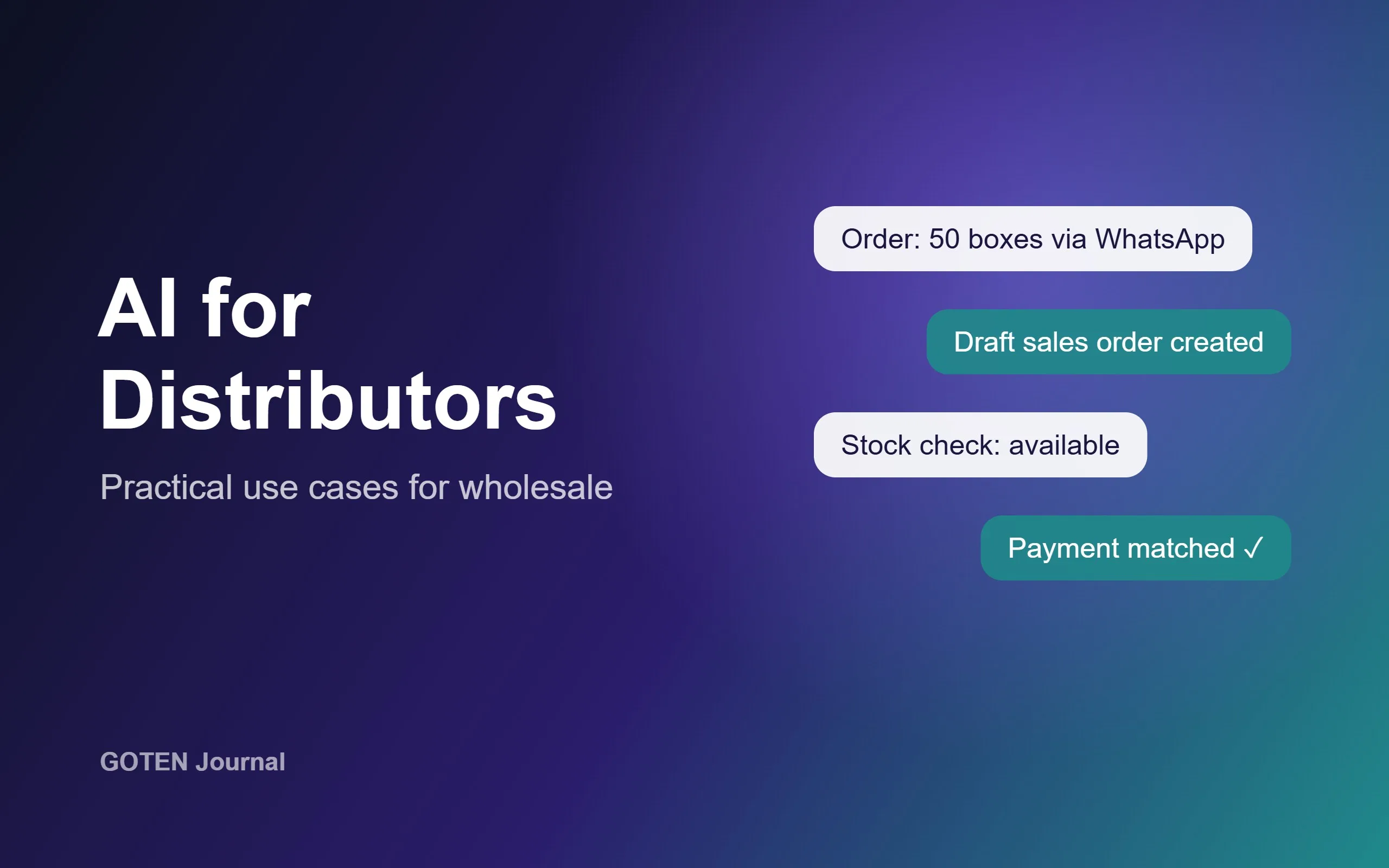
Customers send orders as chat messages, photos of handwritten lists or PDF purchase orders. AI can read them, match products to your catalogue, flag unclear items and create a draft sales order for admin to confirm. This alone can save hours every day.
2. Instant price and stock answers
An assistant connected to your price list and stock data can answer "Is item X available, and what is the price for 50 boxes?" within seconds, even outside office hours, and pass complex requests to sales. See AI chatbot vs live chat for how to combine automation with your team.
3. Quotation drafts
For project or B2B buyers, AI can turn a request into a quotation draft using your pricing rules and templates. Salespeople review and send. Our guide to AI for sales covers this workflow in more detail.
4. Supplier invoice and delivery note processing
AI reads supplier invoices and delivery notes, extracts amounts and line items, checks them against purchase orders and highlights differences for finance. The full approach is explained in AI document processing.
5. Payment confirmation matching
Customers often send transfer screenshots on WhatsApp. AI can read the amount, date and sender, match them to open invoices and prepare a list for finance to confirm.
6. Internal product and policy assistant
New sales and admin staff can ask about product specifications, substitutes, credit terms or return rules and get answers from your own documents. This is an AI knowledge base applied to distribution.
7. Daily summaries for managers
AI can turn the day's orders, outstanding deliveries, overdue payments and stock alerts into a short written summary each morning, so managers act on exceptions instead of reading every report.
How to prioritise
Score each use case on four simple questions:
- How many times a day does the task happen?
- How many staff hours does it take today?
- How costly are mistakes, such as wrong items shipped or missed payments?
- Is the data the AI needs, such as price lists, catalogue and stock, already clean and in one place?
For most distributors, order intake and price or stock answers score highest, followed by document processing. Start with one, prove it in a short pilot, then expand.
Getting the data ready
AI is only as good as the information it reads. Before launching, make sure you have:
- A clean product catalogue with consistent names, codes and units.
- One current price list, including customer-specific pricing rules if you use them.
- Stock data that updates at least daily, ideally from your inventory or ERP system.
- Clear rules for credit terms, minimum orders and delivery areas.
Risks and how to manage them
- Wrong prices or stock. Keep a person approving orders and quotes until accuracy is proven.
- Customer data. Names, phone numbers and purchase histories are personal data under Indonesia's Personal Data Protection Law. Follow our AI data privacy checklist.
- Over-automation. Do not let AI change credit limits, cancel orders or contact many customers without approval.
- Team adoption. Involve admin and sales staff early; they know the exceptions the system must handle.
An example morning with AI support
Picture an admin team that used to spend the first two hours of every day retyping WhatsApp orders. With AI order intake, those messages are already turned into draft sales orders when the team arrives. Admin checks the flagged items, such as unclear product names or quantities above stock, confirms the rest and moves on to customer calls. Finance receives a list of matched payment screenshots, and the sales manager reads a one-page summary of yesterday's orders and today's priority deliveries.
FAQ
Do we need an ERP before using AI?
No. Many distributors start with spreadsheets and WhatsApp. An ERP makes integration easier later, but it is not required for a first pilot.
Can AI read handwritten order lists?
Often, if the writing is reasonably clear. Expect more human review for handwritten documents than for typed ones.
How quickly can we see results?
A focused pilot on one use case can show measurable time savings within a few weeks. Our 30-day AI pilot plan explains how to measure them.
A simple starting plan for AI for distributors
If you are unsure where to begin, follow this order: clean the catalogue and price list, automate price and stock answers, then add order intake, then document and payment matching. Each step reuses the data and integrations from the one before, so the investment builds up instead of starting from zero each time. Review results monthly with sales, admin and finance together.
Bring AI to your distribution business with GOTEN
We build AI solutions for order intake, document processing, sales and internal knowledge, connected to the tools distributors already use. See our AI solution development services or read the full AI for business guide.